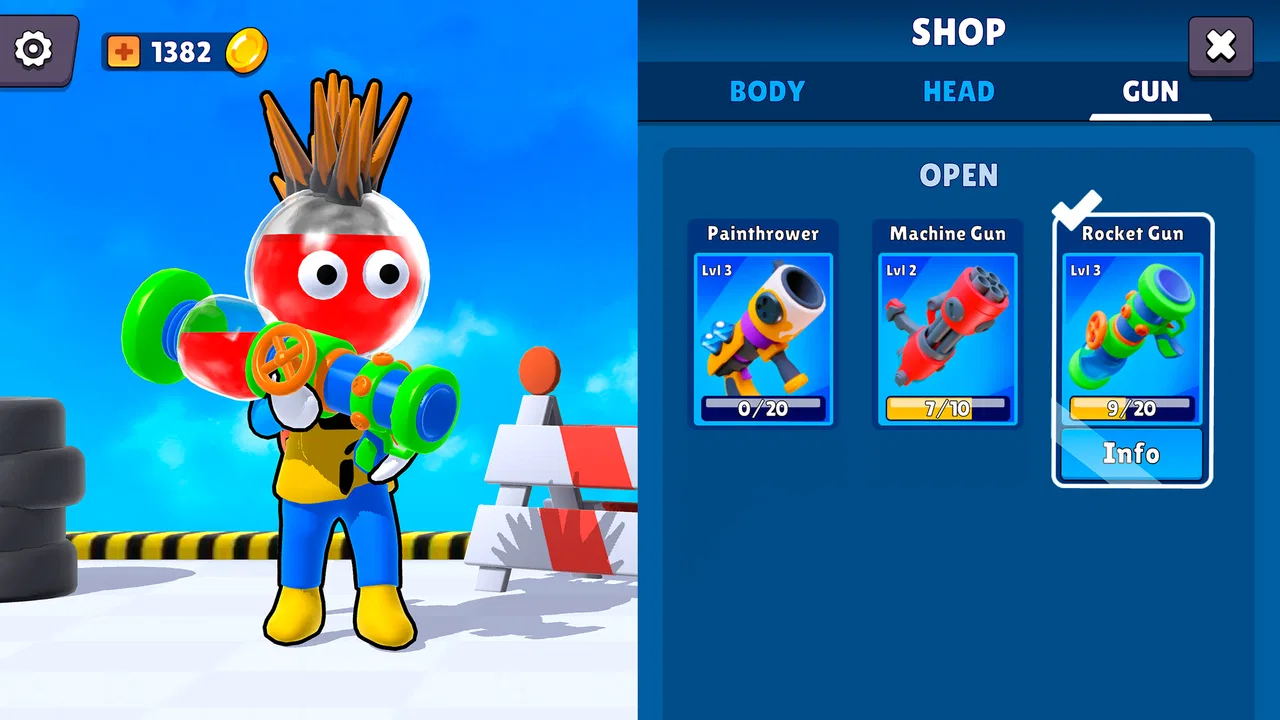
Dye Hard - Color War
- 4.4
- Rating
- 50.00M
- Installs
- Free
- Price

 Analysis by App-foxy
Color is the whole point of Dye Hard - Color War, but the interesting part is how quickly that simple idea turns into a tense action game. I move through compact arenas, cover surfaces in my team’s color, and try to leave more territory behind than the opposing side. It is easy to understand in a few seconds, yet the best results come from choosing where to go rather than painting whatever is directly in front of me.
That makes this a good fit for short mobile sessions. I can start a round without learning a large set of controls, make progress through quick decisions, and close the game when I only have a few minutes. At the same time, the colorful presentation gives the action a playful look that suits its Everyone content rating. Developed by CASUAL AZUR GAMES, it is a free action game for Android, with the current release listed as version 0.10.13 and support beginning with Android 6.0.
Why controlling color matters more than simply moving
The central capability is not just shooting paint or changing the appearance of a surface. It is using color as a visible record of control. Every area I cover becomes a clue about how the round is developing: a broad patch can show that my team is expanding, while an untouched strip may reveal a route the opponent can use to catch up.
You May Also Like

 Blood Strike: 2.5 Anniversary
Blood Strike’s Loadouts Turn Every Drop Into a Tactical Gamble
A close look at Blood Strike’s custom loadouts: how fast access to signature weapons reshapes its battle royale rhythm, rewards preparation, and narrows the gap between fights.

 Pandora - Music & Podcasts
Pandora’s Music Is Easy to Start, but Harder to Recover
Pandora’s strength is its low-effort path from a seed to a station. Its weak spot is how much confidence it asks you to place in connection, setup, and quiet recovery.

 8 Ball Pool
 Is Built on Rivalries, Rematches, and Routine
A close look at the rivalries, rematches, shared routines, and unanswered safety questions that turn a quick pool match into a persistent mobile community.

 Samsung Music
’s Quiet Strength Is Playing What You Already Own
Its reach comes less from spectacle than from dependable access to a personal library. That simplicity is both the app’s strongest retention engine and its ceiling.

 AccuWeather: Weather Radar
AccuWeather Review: A Quick, Clear Forecast for Everyday Decisions
For everyday plans, the best forecast is the one you can understand quickly. AccuWeather makes rain timing, radar, and local conditions easy to act on, with a few trade-offs.

 Hill Climb Racing
Why Hill Climb Racing Still Turns Crashes Into One More Run
A tiny car, a bumpy hill and one more upgrade: Hill Climb Racing keeps resurfacing because its simple chaos makes every near-miss feel personal.
More From Our News Desk



I like this because it gives movement a purpose. In a more ordinary casual action game, running around can feel like the main activity, with the objective added almost as an afterthought. Here, movement is tied to territory. I have to think about whether it is better to extend a safe area, push toward contested ground, or circle around and reach a section that has been ignored.
The visual feedback is especially useful on a phone screen. I do not need to remember a complicated score system to understand the situation. The colors communicate progress immediately. If my side has filled most of the visible arena, I can see that we are in a strong position. If the floor is divided into messy patches, I know the result may change quickly.
The strongest idea in Dye Hard is that painted space becomes a tactical map. That is also why the game can feel more engaging than its basic premise suggests. I am not only trying to finish an action; I am trying to shape the arena so the next action becomes easier.
Reading the arena before committing
My first useful habit was to pause mentally at the beginning of a round instead of immediately rushing forward. I look for open sections, narrow passages, and areas that seem likely to become contested. Covering a large, easy section can create a comfortable lead, but it may also leave the important middle ground available to the other team.
A better approach is often to balance visible progress with positioning. If I spend too long completing one corner, I may return to find that the opponent has taken the routes connecting it to the rest of the arena. On the other hand, rushing toward the center without establishing any secure color can make my progress easy to erase or overwhelm.
This creates a small but meaningful trade-off between expansion and control. New players can enjoy the immediate satisfaction of spreading color, while experienced players begin to ask whether each painted area helps the next move. That extra layer is what keeps the concept from feeling like a purely decorative activity.
How a typical session feels in practice
In everyday use, I would describe the rhythm as quick, visual, and slightly chaotic. I enter a round, move through the arena, watch the colored ground change, and react to whatever part of the map appears most valuable. The controls are approachable enough for casual play, so the challenge comes less from memorizing commands and more from judging timing and direction.
That accessibility is important on mobile. I do not want to spend a spare moment configuring a complicated control scheme before I can enjoy a match. The game’s appeal is strongest when I can pick it up, understand the objective, and immediately make a meaningful choice about where to go.
There is also a useful difference between seeing a large amount of color and actually having a good position. A wide painted patch can look impressive, but if it is isolated from the rest of the team’s area, it may not provide much practical advantage. I learned to treat disconnected progress cautiously. A smaller connected route can be more valuable than a larger patch that leaves me exposed.
For that reason, I recommend checking the borders of your team’s color before making a long push. Expanding from an existing area gives a clearer sense of direction and makes it easier to recognize when the opponent is approaching. This is a simple tip, but it changes the game from random movement into deliberate coverage.
A realistic five-minute use case
Imagine waiting for a bus or taking a short break between tasks. This is where the game makes the most sense to me. I can play a brief session without needing a long uninterrupted story, a large inventory to manage, or a complicated objective to remember. The visual goal is immediate, so I can return after a day away without having to relearn a plot or rebuild a strategy from notes.
I would not use it when I am looking for a deep competitive experience that demands long practice sessions. I would choose a more complex action game for that. Dye Hard works better as a focused burst of territory competition, where the pleasure comes from reacting quickly and seeing the arena change under my decisions.
It is also suitable for players who enjoy colorful games but do not want a heavy fantasy setting or an elaborate progression system to understand. The paint-based conflict keeps the presentation light, while the action category gives the session enough urgency to avoid feeling like a passive coloring activity.
Small decisions that improve results
One of the most useful techniques is to avoid treating every uncolored area as equally important. I first look for sections that connect several routes or sit close to the opponent’s likely path. Painting these areas can influence how the rest of the round develops, even if they do not produce the biggest immediate visual change.
Another tip is to resist chasing a single moving target when doing so abandons your team’s existing coverage. A chase can feel exciting, but it may pull me away from the area that actually determines the result. I get better outcomes when I check whether the pursuit helps expand control or merely keeps me busy.
I also try to finish a practical route before making a risky detour. Connecting two colored sections can make the map easier to read and gives me a clearer fallback position. This is not a flashy tactic, but it reduces the number of moments where I become lost in the visual noise of a changing arena.
Finally, I pay attention to the final moments rather than assuming the leading color is safe. A large-looking advantage can disappear if important gaps remain. The best endgame behavior is often a quick inspection of unfinished areas, followed by a direct move toward the most valuable open space rather than aimless extra movement.
Where the game feels strongest
The strongest scenario is casual play with a competitive edge. I can enjoy the bright look and straightforward objective, but I still have enough control over the result to feel that my choices matter. The game does not require me to become an expert before I can have fun, yet it rewards better route planning once the basic idea becomes familiar.
It is particularly effective for players who like action games based on map control but find traditional versions too demanding. The color system explains the state of the arena at a glance, so I spend less time studying menus and more time making decisions. Someone who enjoys the territory element of larger multiplayer games may appreciate the same broad idea in a more approachable mobile format.
It is less suitable for anyone who needs a long-form campaign, detailed character development, or a large variety of carefully explained systems. The attraction here is the repeated loop of entering an arena, spreading color, and responding to the opposing side. If that loop does not sound satisfying, the bright presentation alone will not carry the experience for very long.
Trade-offs behind the simple design
The simplicity is both the game’s greatest strength and its main limitation. Because the objective is so clear, I can start quickly. However, players who want a wide range of weapons, story missions, or deep customization may find the experience narrower than a conventional action title. The focus stays on colored territory, so the game does not try to be everything at once.
Another trade-off is that visual clarity matters enormously. When several colors and movements compete for attention, I sometimes need to slow down and read the arena rather than react to the most obvious motion. That can be exciting, but it can also feel hectic if I am playing on a small display or in a distracting environment.
The free entry point makes it easy to try, though optional purchases are listed from $0.49 to $99.99 per item. I would approach those purchases carefully and decide whether they improve my enjoyment before spending. The core appeal is the color-control action itself, so I would not recommend buying anything simply because a round feels difficult. A short learning period is more valuable than treating every setback as a reason to pay.
That monetization range is worth keeping in mind for families. The game is rated Everyone, which makes its tone broadly accessible, but adults should still review purchase settings on a shared device. The age rating describes the content, not how a player might choose to spend money inside the app.
How it compares with familiar alternatives
Compared with a traditional arena shooter, this game puts less emphasis on precise combat mastery and more on visible control of space. I do not need to memorize a large arsenal to understand what went wrong. If I lose ground, I can usually look at the arena and identify whether I expanded too slowly, ignored a route, or left valuable gaps.
Compared with a simple coloring game, it adds urgency and opposition. The colors are not only an artistic result; they represent a changing contest. That difference gives each session a stronger reason to keep moving, while still retaining the approachable visual language that makes casual games comfortable.
Compared with a large strategy game, it offers a much lighter commitment. I do not have to manage a long-term economy or study extensive menus before making a decision. The compromise is that the strategic layer is concentrated into movement, coverage, and timing. Players who want detailed planning over hours will find more depth elsewhere, while players who want immediate map pressure may prefer this format.
Who will get the most from it
I would recommend Dye Hard to people who enjoy quick action, strong visual feedback, and objectives that can be understood without a tutorial-heavy introduction. It is also a good choice for players who like turning a simple rule into a personal strategy. The deeper enjoyment comes from discovering that the best route is not always the most obvious one.
It should appeal to families and younger players who want a colorful action experience with an Everyone rating, provided purchases are handled responsibly. It can also work for adults who want something easy to launch during short breaks but still prefer a game with decisions instead of a completely passive time filler.
I would skip it if my priority were a story-driven adventure, a highly technical competitive shooter, or a large progression system that keeps unfolding for dozens of hours. I would also be cautious if I dislike repeated arena-based rounds or become frustrated by visual competition between multiple colored areas. The game’s identity is very focused, and that focus will feel refreshing to some players but limited to others.
Device expectations and practical details
The Android requirements are modest, with compatibility starting at Android 6.0, so the game is positioned for a broad range of devices rather than only recent phones. I still prefer playing on a screen where colored regions are easy to distinguish, because the entire tactical layer depends on reading those changes quickly.
Its popularity also suggests that the format has reached a wide mobile audience: the game has passed 50 million installs, with an average rating of 4.4 from around 128 thousand ratings and roughly 3.2 thousand written reviews. I see those figures as useful context rather than a substitute for personal taste. They show that the simple color-war concept has broad appeal, but they do not change the fact that the repeated loop may not suit players seeking a different kind of action.
The game is free to start, which is the right arrangement for this sort of compact action experience. I can test whether the movement and territory loop work for me before deciding whether it deserves a regular place on my phone. That trial is especially valuable here because the concept is immediately understandable, but its long-term appeal depends on how much I enjoy refining routes and reacting to changing control of the arena.
My overall recommendation
After spending time with it, I see Dye Hard as a focused action game built around one effective idea: color is both the reward and the information I use to make my next decision. The game works best when I stop treating painting as a simple task and start treating every colored section as part of a route, a boundary, or a possible advantage.
It is not a replacement for a deep shooter or a full strategy game, and its narrow loop will not satisfy everyone. For short sessions, however, it offers a clear objective, immediate feedback, and enough tactical choice to make repeated rounds more interesting than the store summary might suggest. If you want a free, colorful action game where controlling space matters more than collecting complicated systems, this is an easy one for me to recommend trying.
FAQs for Dye Hard - Color War
01What is the main objective of Dye Hard - Color War?
In Dye Hard - Color War, the primary objective is to cover as much territory as possible in your team's color. Players compete in vibrant, fast-paced battles, using various tools and strategies to outmaneuver opponents and dominate the battlefield. Winning requires a blend of quick reflexes, strategic planning, and teamwork.
02Is Dye Hard - Color War free to play?
Yes, Dye Hard - Color War is free to download and play. However, it does offer in-app purchases that can enhance gameplay, such as cosmetic items and power-ups. These purchases are optional and not necessary to enjoy the full experience of the game, but they can provide additional customization and advantages.
03What are the system requirements for Dye Hard - Color War?
For Android users, Dye Hard - Color War requires Android version 5.0 and up. For iOS devices, iOS 10.0 or later is necessary. The game is optimized for both smartphones and tablets, ensuring smooth performance and vibrant graphics, provided the device meets these minimum requirements.
04Can I play Dye Hard - Color War with friends?
Yes, Dye Hard - Color War features multiplayer modes that allow you to team up with friends or compete against them. You can join existing matches or create private rooms to invite friends. The social aspect enhances the fun, making it a great way to connect and compete with others.
05Are there any parental controls available in Dye Hard - Color War?
Dye Hard - Color War includes settings that allow parents to manage in-app purchases and screen time, ensuring a safe and controlled gaming environment for children. These controls help prevent unauthorized purchases and excessive gameplay, providing peace of mind for parents while kids enjoy the game.
Pros
- Engaging multiplayer battles
- Vibrant and colorful graphics
- Easy to learn controls
- Frequent updates and events
- Customizable characters
Cons
- Occasional server lag
- In-app purchases can be pricey
- Limited offline play options
- Battery drain during long sessions
- Ads can interrupt gameplay

Dye Hard - Color War
Gallery